Customer Acquisition Cost (CAC) is a critical metric that helps you understand the economics of your marketing efforts. This article explains what CAC is, why it matters, how it's calculated, and how to interpret the results shown in your Marketing Plan Overview.
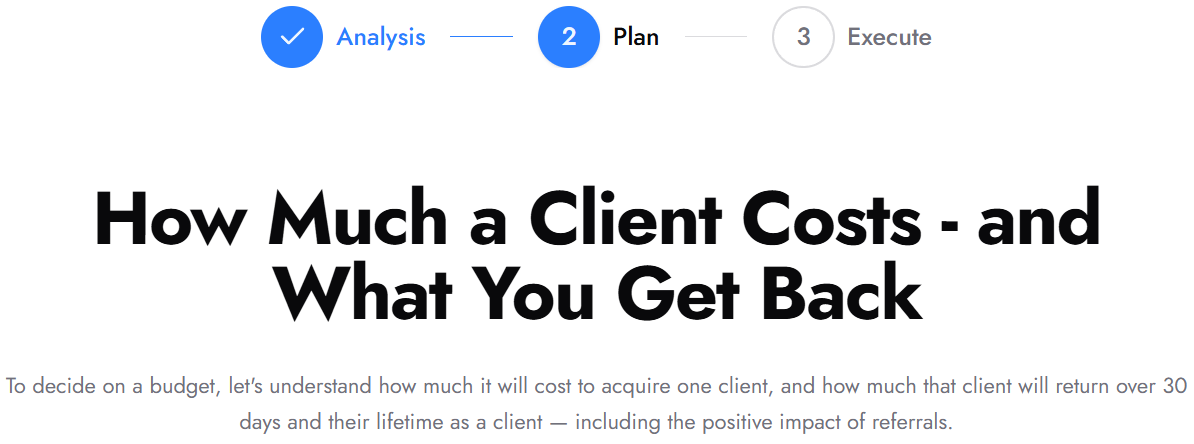
Customer Acquisition Cost (CAC) is the average amount that needs to be invested in marketing to bring in one new customer. In your Marketing Plan Overview, this is shown as "cost per client."
CAC answers a simple but important question:
"How much does it cost, on average, to win one new customer?"
Understanding your CAC helps you see whether your marketing investment makes sense for your business before you move into your growth roadmap.

The CAC overview appears in your Marketing Plan Overview, between your Gap Analysis results and your 12-Month Growth Roadmap. This screen shows:
Cost per client — your calculated CAC
Your plan options — three strategies for reaching your revenue goal
ROI summaries — your projected returns at different timeframes
Break-even analysis — how long until your investment pays off
Navigation — back to your analysis or forward to your roadmap
The Three Plan Options
On this screen you will see up to three growth plan options. Each one targets the same monthly revenue goal but takes a different approach to reach it. You can adjust your goal at any time using the Modify goal link — all three options update instantly.
Fastest Gets you to your goal in the shortest time by focusing on paid advertising such as Google Ads and Facebook Ads. Because it relies more on paid channels, the cost per customer is the highest of the three options. This option works best if reaching your goal quickly is the priority and you have the budget to invest in advertising.

Most Cost Effective The balanced option — the platform describes it as the sweet spot between speed and price. It combines paid and organic marketing to reduce your monthly investment while still reaching your goal within a reasonable timeframe. The cost per customer is lower than Fastest and the return in year one is typically stronger. This is the recommended option for most users.

Cheapest Keeps your monthly investment as low as possible by focusing on organic marketing such as SEO. Because organic channels take longer to generate results, this option may not reach your stated goal within 12 months. When that is the case, the Achievable goal and Time to goal fields will show a dash (—), and the platform will suggest you consider lowering your goal. The cost per customer is the lowest of the three options.

Every option card shows the same information: your achievable goal, the time to reach it, the cost per customer, your projected first-year return, and your projected lifetime return from customers brought in during year one.
CAC is one of the key numbers in your marketing plan. It helps you understand:
Whether your monthly investment is sustainable for your business
How quickly your marketing spend can be recovered through customer revenue
Whether the value each customer brings justifies what it costs to reach them
How referrals can make your overall numbers even stronger
Without CAC, your plan would show budget and revenue projections without explaining whether the investment actually makes sense. CAC gives you that foundation.
Your CAC is calculated by looking at all the marketing channels included in your plan that drive traffic and generate leads — both paid channels like Google Ads and organic channels like SEO. The calculation reflects the actual mix of channels active in your plan.
The formula:
Add up the total 12-month cost of all traffic-driving channels in your plan
Estimate the total number of new customers generated over the plan period
Divide total cost by total customers
CAC = Total marketing spend across plan ÷ Total new customers generated

Beyond CAC, your Marketing Plan Overview shows additional figures to help you understand the full picture of your marketing investment.
Break-Even Point The number of months it takes to recover your CAC through customer revenue.
Break-even months = CAC ÷ average monthly revenue per customer
The result is rounded up to the next whole month, giving you a realistic timeline.
Lifetime Net Revenue The total revenue a customer could generate over their entire time with your business — the long-term value of bringing in one new customer.
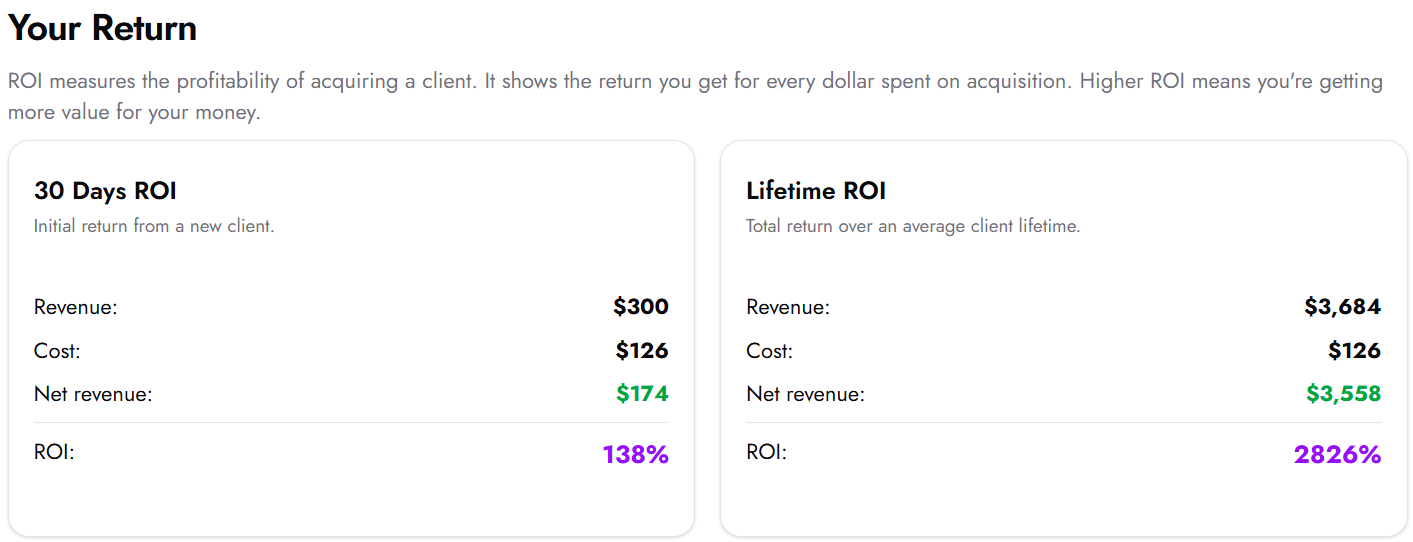
Your overview shows projected returns at two timeframes:
30 Days ROI — the short-term return from one new customer in their first month
Lifetime ROI — the long-term return over an average customer's full time with your business
For each timeframe you will see:
Revenue — total customer revenue generated
Cost — your CAC for that customer
Profit — revenue minus CAC
ROI % — profit as a percentage of your CAC
Profit with Referrals — how word-of-mouth referrals improve your numbers
The ROI % with Referrals shows what your return could look like if customers refer others to your business. If referrals are a meaningful part of how you grow, this figure will be noticeably stronger than the standard ROI and gives a more complete picture of what each new customer is worth.
Several factors influence your CAC:
Which marketing channels are included in your plan
The cost of those channels
How many leads your marketing generates
How many of those leads become customers
How quickly and consistently you follow up with new leads
How well your website converts visitors into enquiries
Your overall customer economics
Your CAC improves when:
Traffic becomes more cost-effective
Website conversion rates increase
Follow-up processes become more efficient
Lead-to-customer close rate improves
Conversely, CAC increases when traffic is expensive, conversion is weak, follow-up is inefficient, or close rates are low.
Q: Why is my CAC higher than I expected?
A: Your CAC reflects the combined cost of all the marketing channels in your plan. A higher CAC usually means the channels being used are more expensive, your website isn't converting as many visitors into enquiries, or leads aren't being followed up quickly enough. Your Gap Analysis will show you where the biggest opportunities to improve are.
Q: How can I lower my CAC?
A: The most effective ways to lower your CAC are improving how your website converts visitors, responding to new enquiries faster, and closing a higher percentage of the leads you receive. Even small improvements in these areas can make a meaningful difference without increasing your marketing spend.
Q: What is a good CAC?
A: A good CAC depends on the value of your customers. As a general guide, you want to recover your CAC within 3 to 6 months, and the total revenue a customer generates over their lifetime should be at least 3 times your CAC.
Q: Do referrals really make that much difference?
A: Yes. When existing customers refer new ones, it reduces the effective cost of bringing in those new customers. A steady flow of referrals can meaningfully lower your overall CAC and increase your profitability over time.